
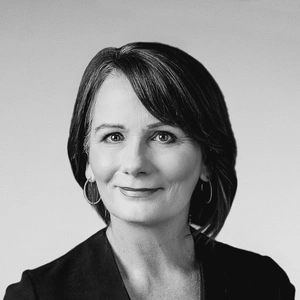

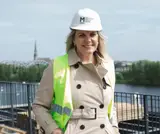
Iluta Gaile, Managing Director at Kestria Latvia, interviewed Iveta Bahmane, Chairwoman of the Board at Mūkusalas Biznesa Centrs, to discuss her professional journey, decision-making across different industries, and the realities of real estate development. The conversation also explores perspectives on leadership, career development, and the challenges of managing and growing within a demanding sector. It highlights the importance of adaptability and accountability in leadership roles, particularly in complex and evolving environments.
What motivated your move into a leadership role?
I have been writing a journal for a long time—not in the traditional sense of recording daily activities, but focusing on my thoughts, aspirations, and the challenges I am facing. Through this process, I can reflect and work through them.
Some time ago, I noticed that at the age of 36, I had written in my journal that I wanted to independently lead a company. Although the idea was quite vague at the time, it eventually materialized. I believe the main reason behind this ambition is that I find it difficult to work in environments where I don’t truly trust the manager. If a leader lacks clarity, does not stand by their decisions, or yields to external pressure, it is challenging for me to accept that.
At that point, I made the decision that I wanted to lead myself, make decisions, and not report to anyone. Of course, in reality, it is not that simple – I also have shareholders in my company to whom I am accountable. However, there is mutual respect here for what they have built and how they run their business. At the same time, I am given a significant degree of freedom to make independent decisions, which is very important to me.
I also find routine work challenging. Repetitive meetings with the same discussions over a prolonged period can become exhausting. It is therefore the responsibility of a leader to ensure that processes remain dynamic and do not become stagnant.
What defines a good leader today—and how has it changed over the past decade?
This question can be approached from two perspectives. One is generational differences—leaders from older generations, such as those over fifty, differ from younger-generation leaders, typically between thirty and fifty.
I have not personally worked under a younger leader; therefore, this perspective is based on observation. Younger leaders may demonstrate greater ambition and a stronger inclination toward globalizing processes across industries. At the same time, the human factor may be somewhat less emphasized, although that is my interpretation.
Within my own generation, the human aspect remains highly important. For example, remote work is not something I strongly relate to, and I find it difficult to see how work can be fully effective without in-person interaction. Presence—people, energy, and direct communication—is important. Younger-generation leaders may approach this differently; however, this is a subjective perspective.
How has your career evolved, and what led you to transition into real estate development?
My professional development has evolved alongside the industries in which I have worked. I spent more than a decade in the banking sector, then moved to Tet (formerly Lattelecom), and later transitioned into real estate development. Each step contributed to expanding my expertise and perspective.
The transition itself happened quite naturally. During my maternity leave, I remained intellectually active and open to new opportunities. At that time, I was approached by Klāvs Vasks, now a co-owner of Ltd Mūkusalas Biznesa Centrs, and this led to the opportunity to enter the real estate sector.
Although I initially had concerns about moving into an unfamiliar industry, I accepted the challenge. In retrospect, the transition proved to be more manageable than expected and reinforced the value of stepping outside one’s comfort zone.
More broadly, I believe that changing industries brings significant benefits and can be compared to acquiring an additional degree, as it requires continuous learning. This remains true in my current role, where I continue to develop expertise, particularly in construction and financing.
What are the key trends shaping real estate in Latvia over the next five years?
The real estate market can be viewed across two main segments: residential, and office and industrial, including logistics and commercial buildings.
In the office segment, development has been relatively limited in recent years, with only a few projects currently underway. This suggests that demand is being met gradually rather than through rapid expansion.
In contrast, the residential segment is more active, with numerous projects in development. This reflects a recovery in demand and a shift toward newer, more modern housing.
Another important trend is the growing focus on neighborhood development. In our case, we are actively shaping the area around Ltd Mūkusalas Biznesa Centrs, which is gaining importance due to its strategic location and ongoing urban development.
This type of development requires close cooperation between developers, local communities, and municipalities. Broader initiatives, such as infrastructure and mobility improvements, depend on alignment and shared responsibility. For this reason, we have launched a neighborhood development initiative to encourage wider engagement and collaboration.
What are the biggest challenges in real estate development projects?
The main challenge is construction. Ideally, a developer, as the client, signs a contract, finances the project, and expects the result. In reality, however, the process is much more complex. The client signs an agreement with a general contractor, who in turn works with multiple subcontractors. Within this chain, problems often arise. A subcontractor may lack financial resources, workforce, or face other difficulties. These issues gradually move up the chain to the general contractor and ultimately reach the client.
As a result, developers often need to be directly involved in the construction process to resolve challenges and ensure progress. This has made dedicated project management essential, particularly as project complexity continues to increase.
In the office and commercial segment, pre-agreed tenant deadlines add further pressure. Delays in construction can lead to complications in tenant relationships, requiring proactive management and, in some cases, changes in partners.
Overall, construction remains one of the most significant challenges for developers, especially in the final stages of project delivery.
What is more challenging in leadership: decision-making or managing people?
The most challenging aspect of leadership is working with people, particularly in building the right team. Strong teams are formed when individuals share common values. It is not only about qualities such as diligence, but also about what truly motivates individuals and how their values align with the organization.
In our case, family is an important value, which creates alignment and contributes to a strong internal culture. Building such a team requires time, but once established, it reduces unnecessary tension and improves overall effectiveness. Individuals with significantly different priorities or lifestyles may find it more difficult to integrate into this environment.
Managing people becomes especially complex in situations that require alignment and consistent follow-through. When agreements are not upheld, issues tend to recur, requiring additional time and energy to resolve. There are also situations where, despite all efforts, common ground cannot be reached. In such cases, it may be necessary to seek external support, involve a third party, or delegate the issue.
Overall, managing people remains one of the most demanding aspects of a leadership role.
Can you share an example of a difficult leadership decision?
One of the most challenging periods in my career followed the 2009 financial crisis in Latvia. At that time, banks had overfinanced many clients, particularly in the leasing sector. I was leading the leasing function, and the situation was highly complex. We were required to manage a large number of repossessed assets, often selling them at a loss due to limited market demand. At the same time, the bank made a strategic decision to reduce headcount, as business volumes were not expected to recover.
Within my team, I had to make the decision to let go of approximately fifteen employees, including some on maternity leave, which made the situation particularly difficult from a human perspective.
These discussions were demanding, as employees faced personal and family considerations. However, from a business standpoint, there was no alternative, as the roles were no longer sustainable. Situations like this require leaders to balance human considerations with organizational needs, making difficult but necessary decisions.
At Ltd Mūkusalas Biznesa Centrs, workforce reductions are less frequent and typically linked to performance. In smaller organizations, individual contributions are more visible, and decisions are generally based on results, timeliness, and level of engagement.
What is the biggest myth about leadership?
The biggest myth is that a leader does not need to be actively involved—that their role is limited to assigning tasks and attending meetings. In reality, effective leaders remain closely connected to day-to-day operations. While they do not focus on every detail, they maintain a clear understanding of what is happening within the organization and do not rely entirely on others without sufficient insight.
There are many examples of leaders placing excessive reliance on their teams, which can result in a loss of control and negatively impact the organization. While trust is essential, it must be balanced with active involvement and awareness. Through their actions and attitude, leaders must demonstrate commitment to the company’s development. Leadership is not only about results, but also about responsibility and engagement.
What career advice would you give your younger self?
If I were to give myself one piece of advice, it would be to be more courageous. While I may appear confident from the outside, and a sense of humor is certainly helpful, there are also moments of vulnerability, which are entirely natural.
I have observed that entrepreneurs often take action first and reflect afterward, albeit within a reasonable framework. In contrast, I tend to analyze situations in depth, assess risks carefully, and consider multiple perspectives before acting.
For this reason, I would encourage myself to demonstrate greater courage, both at the beginning of my career and moving forward.
What advantages do women bring to leadership in real estate?
I often approach situations with a high degree of personal responsibility and adaptability. When a result needs to be achieved, I am willing to apply a range of different approaches, adjusting my style to the situation and the individuals involved.
In some cases, this requires stepping beyond conventional frameworks and testing alternative approaches to identify what is most effective. Not all approaches are successful, particularly when working with highly experienced counterparts; however, this flexibility and willingness to adapt have proven to be valuable.
This adaptability may also be considered a strength often associated with diverse leadership perspectives. Ultimately, my focus remains on achieving the desired outcome, maintaining persistence, and continuously seeking solutions until the objective is reached.
About Mūkusalas Biznesa Centrs
MŪKU SALA (Mūkusalas Biznesa Centrs) is one of the largest business and office complexes in Riga, offering a wide range of office, commercial, and warehouse spaces within a modern, well-developed business environment. Located along Mūkusalas Street, the complex comprises multiple renovated and newly built buildings, providing flexible premises, contemporary technical infrastructure, and services tailored to the needs of both growing and established companies. The area has undergone a significant transformation from a former industrial zone into a dynamic business quarter, with a strong focus on sustainability, infrastructure development, and creating a vibrant professional community that brings together diverse tenants and industries.