


Kestria’s Global Internal Survey captures insights from senior partners across 40+ countries and 90+ cities. The findings reveal a clear pattern: the value of executive search is shifting decisively toward decision-critical advisory — especially in moments where leadership risk is highest and future readiness is uncertain.
The survey highlights the evolving role of executive search and where true differentiation now resides. Value is increasingly defined by the ability to shape and guide high-stakes leadership decisions, mitigate organisational risk, and help clients appoint leaders who are equipped not only for today’s demands, but to navigate future challenges and opportunities. Together, these trends are reshaping C-suite hiring and leadership strategy globally.
The five insights that follow outline how leadership expectations are evolving — and what this means for organisations navigating 2026 and beyond.
Building on our previous report, The future of executive search and the trends shaping leadership hiring, this year’s insights explore how executive search is evolving into a strategic risk management.
Executive summary (for CEOs / Boards)
Five critical insights define this shift:
1. Transformation and Succession Are the Two Major “Leadership Risk Moments”: Demand for strategic advisory support is strongest in organisational transformation (82%) and leadership succession (74%). These situations amplify the cost of a wrong decision and require structured leadership decision architecture — not just candidate delivery.
2. Executive Search Is Evolving from “Search Execution” to Decision-Critical Leadership Advisory: Nearly three quarters of respondents report that clients value advisory either equally to execution (37%) or see it as a clear differentiator (36%). The role of the executive search partner is expanding into guidance, market intelligence and stakeholder alignment at the highest level.
3. Future Readiness Has Become a Core Leadership Requirement — Yet Assessment Still Lags Behind: Future capabilities such as strategic agility, systems thinking and AI literacy are increasingly expected in leadership mandates (43% strongly expect; 21% always expect). However, many organisations continue to evaluate primarily on track record, creating a gap between expectation and assessment practice.
4. AI Is the Entry Ticket — Human Intelligence Defines Differentiation: AI adoption is near universal (95%). While technology improves efficiency, it does not guarantee better leadership decisions. Differentiation shifts to judgment, contextual interpretation and the ability to distinguish true leadership capability from surface-level presentation.
5. The Market Is Polarising — Premium Advisory Wins as Delivery Becomes Commoditised: As execution becomes easier to replicate, long-term value migrates toward trusted advisory partnerships. The market is increasingly splitting between high-end retained advisory and commoditised delivery models.
Overall implication:
Executive search has become a form of strategic risk management.
The premium executive search partner is no longer defined by access to candidates, but by the ability to structure complex decisions, assess future leadership relevance, and provide confidence in moments where the stakes are highest.
„‘Over the past 12 months in EMEA, leadership decision-making has shifted from authority-driven certainty to courage under complexity. The strongest leaders are no longer those who decide fast, but those who balance data with judgment, agility with long-term vision, and performance with humanity. In a volatile market, trust, transparency and adaptability have become the true currency of leadership.’“

Katerina Meimaroglou
Transformation and succession are the two major “leadership risk moments”
Across our global mandates, we observe that demand for strategic advisory support is highest in situations where leadership risk is greatest — particularly during organisational transformation and leadership succession. In these moments, the cost of a wrong C-suite hire is amplified, stakeholder alignment becomes more complex and the leadership context often changes faster than the organisation can adapt.
This increases the need for executive search partners who can structure decisions, reduce risk and ensure alignment beyond the job description.
Survey signal: Respondents identified the strongest need for strategic advisory support in organisational transformation (82%) and leadership succession (74%).
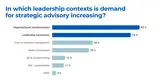
Meaning: These are the moments where leadership decisions carry the highest risk and where clients require decision architecture, not just candidate delivery.
Kestria angle: Kestria’s senior-led approach and cross-border market intelligence enable clients to make high-stakes leadership decisions with greater confidence.
Leadership takeaway: When the stakes are highest, invest in decision structure — not just speed.
Executive search is evolving from “search execution” to decision-critical leadership advisory
Client expectations are shifting from pure delivery toward advisory depth. Increasingly, executive search partners are expected to provide orientation, market intelligence, and guidance on leadership, culture and transformation — especially when organisations face strategic uncertainty. This marks a clear move away from transactional hiring and toward executive search as a decision-support function at the highest level.
Survey signal: Nearly three-quarters of respondents report that clients value advisory either equally to execution (37%) or see it as a clear differentiator (36%).
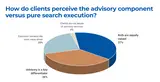
Meaning: Executive search is moving beyond process execution toward trusted leadership advisory in uncertain contexts.
Kestria angle: Kestria’s owner-led model supports high-touch advisory, especially in complex leadership transitions and transformation mandates.
Leadership takeaway: Choose partners who can challenge your assumptions, not just confirm your brief.
Future readiness has become a core leadership requirement — yet assessment still lags behind
The survey shows that future skills and future readiness are now explicitly expected in executive hiring, particularly at the C-suite and board level. Capabilities such as strategic agility, learnability, systems thinking, emotional intelligence and AI literacy are increasingly seen as essential for leadership success in uncertain markets. At the same time, many organisations still rely heavily on track record-based evaluation, creating a gap between what is expected and what is consistently assessed.
Survey signal: Future skills are increasingly expected by clients: 43% strongly expect them, and 21% always expect them in leadership hiring. Strategic agility was ranked as the #1 future capability for leadership success.
Meaning: The market is shifting from evaluating past success to predicting future leadership relevance — but many assessment approaches still lag behind this expectation.
Kestria angle: Kestria actively integrates future readiness into role definition, candidate evaluation, and advisory discussions — enabling clients to hire leaders for what comes next, not what worked before.
Leadership takeaway: If future capability is not rigorously assessed, leadership decisions rely on optimism rather than evidence.
AI is the entry ticket — human intelligence defines differentiation
AI adoption in executive search has reached a point where it is no longer a competitive advantage, but a baseline expectation. While GenAI tools accelerate sourcing, research and content production, they also increase noise through polished candidate narratives and standardised outputs. As a result, clients increasingly value the human ability to interpret context, challenge assumptions and distinguish real leadership capability from surface-level presentation.
Survey signal: GenAI adoption is near universal (95% use GenAI tools), with 0% reporting negative impact — yet 27% see no measurable impact so far, showing that tools alone don’t guarantee better outcomes.
Meaning: AI has become hygiene. Differentiation shifts to judgment, context, trust and decision quality.
Kestria angle: Kestria combines AI-enabled speed with human intelligence to turn information into a decision advantage.
Leadership takeaway: As AI increases credible-looking options, raise the bar for judgment and evaluation.
„‘In APAC, leadership decisions have become noticeably faster and more exposed as leaders navigate transformation, succession, geopolitical tension and AI-driven change. More decisions are being made closer to customers, informed by real-time data and local insight, while regional leaders focus on resilience, ecosystems and long-term stakeholder value rather than short-term wins. I’d describe the shift as moving from reactive decision-making to a more proactively agile approach that anticipates disruption instead of merely responding to it.'“

Steven B. McKinney
The market is polarising — premium advisory wins as delivery becomes commoditised
Executive search is increasingly splitting into two models: high-end retained advisory versus commoditised candidate delivery. AI accelerates this polarisation by making information and execution easier to replicate, while raising expectations around speed and transparency. As delivery becomes more standardised, clients differentiate partners based on advisory depth, trust, assessment quality and the ability to provide decision confidence.
Survey signal: The survey highlights rising expectations around advisory depth and relationship-based trust, while AI accelerates efficiency and standardises execution — making delivery easier to replicate.
Meaning: The market is splitting into premium advisory vs. commoditised delivery models, with long-term value shifting to trusted leadership partners.
Kestria angle: Kestria is positioned on the premium side through senior-led advisory, deep market intelligence and global reach with local credibility.
Leadership takeaway: If executive search is treated as a commodity, outcomes will follow commodity logic.
„'In Canada, leadership decision-making has become more thoughtful and more disciplined over the past year. Leaders are still driving transformation, but they’re asking tougher questions about capital, risk, and execution. It’s less about bold statements and more about making well-judged decisions — with accountability and long-term, sustainable impact in mind.'“

Celine Chabee
What this means for organisations
As leadership decisions become more exposed and less reversible, executive hiring is increasingly a form of strategic risk management. The value of executive search will be defined less by access and speed — and more by the ability to structure high-stakes decisions, assess future relevance, and build stakeholder alignment when the context is shifting.
In this market, premium outcomes will come from trusted advisory partnerships that combine global perspective with local credibility — and technology with human judgment.