Future skills at C-level Future skills events for executives

Published
Oct. 5, 2025
Future skills at C-level - Future skills events for executives
Change, uncertainty, crises: what was true yesterday is already outdated tomorrow – and that also applies to leadership. What future skills are needed at C-level? Where do companies stand? In September, Viavanta invited executives to discuss the future of leadership. The conclusion: future skills affect everyone.

Human competence and artificial intelligence as management tools

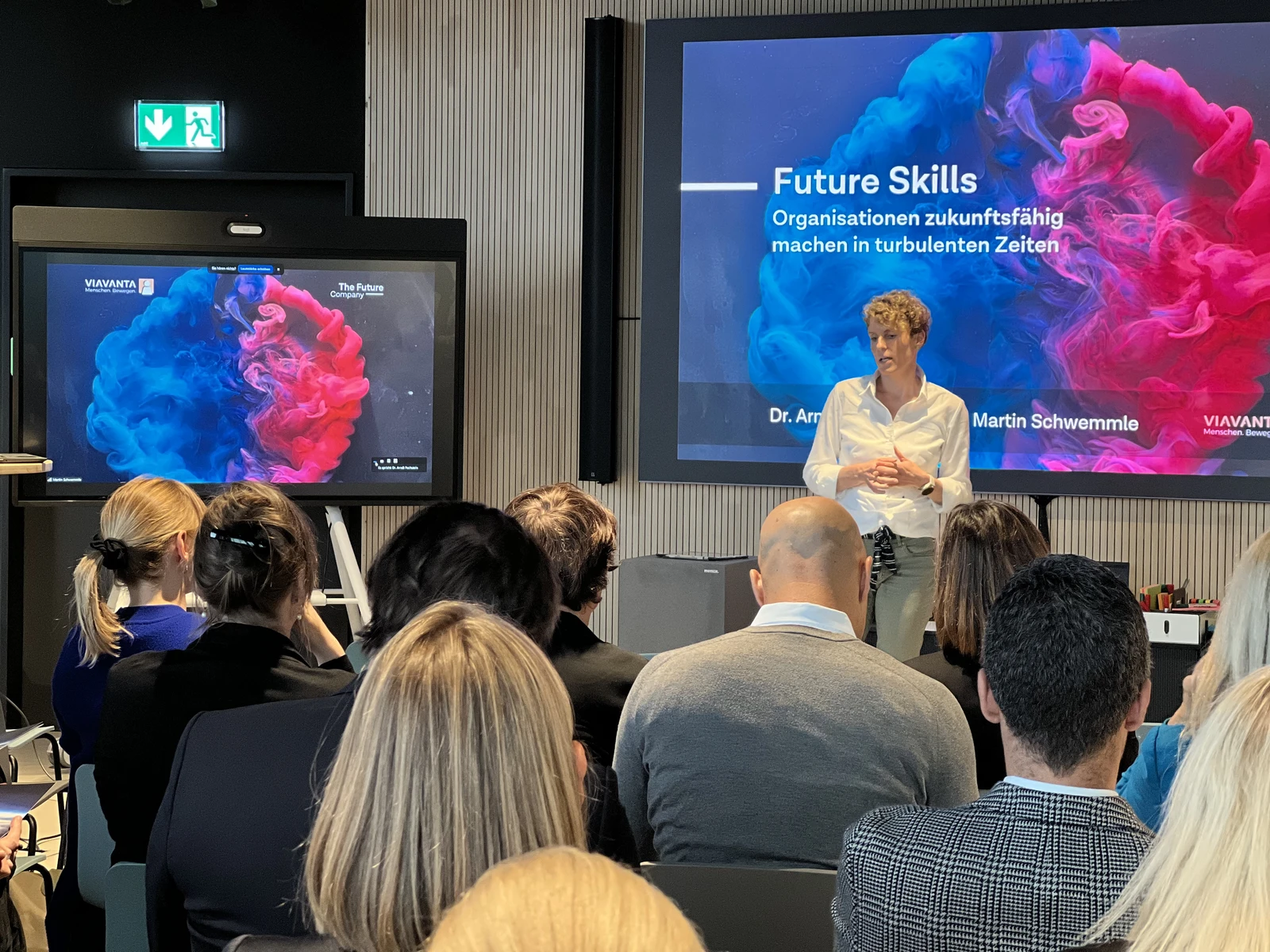
In September 2025, two further Future Skills events took place with over 70 leaders in attendance – the keynote speech by Dr Arndt Pechstein and Dr Martin Schwemmle from The Future Company led to lively discussions and plenty of inspiration.

AI is rapidly changing the rules of the game – decisions are becoming more complex and uncertain, and leadership needs to be rethought. This is precisely why a growth mindset is becoming so important: the ability to question the old, embrace the new and learn continuously. The focus was on the tension between artificial intelligence (AI) and human intelligence (HI) – and what this means in concrete terms for one's own leadership role.

Only through openness to change, a willingness to learn and the courage to let go of the familiar can leadership remain viable for the future.

Eveline Muhmenthaler begrüßt die Gäste

Blockades and the importance of a Growth Mindset

It is often internal blockages that slow companies down. ‘We've always done it this way’ or ‘We don't have the resources for that’ – typical phrases that symbolise a fixed mindset.

The future needs resources – and the right attitude: a growth mindset. A view of potential based on the motto ‘What if?’ that opens up new possibilities and initiates pilot projects. Just do it instead of talking it to death. And thinking in scenarios that turn uncertainty into opportunity.

This creates the space in which innovation can truly grow.

It is often internal blockages that slow companies down. ‘We've always done it this way’ or ‘We don't have the resources for that’ – typical phrases that symbolise a fixed mindset.

The future needs resources – and the right attitude: a growth mindset. A view of potential based on the motto ‘What if?’ that opens up new possibilities and initiates pilot projects. Just do it instead of talking it to death. And thinking in scenarios that turn uncertainty into opportunity.

This creates the space in which innovation can truly grow.

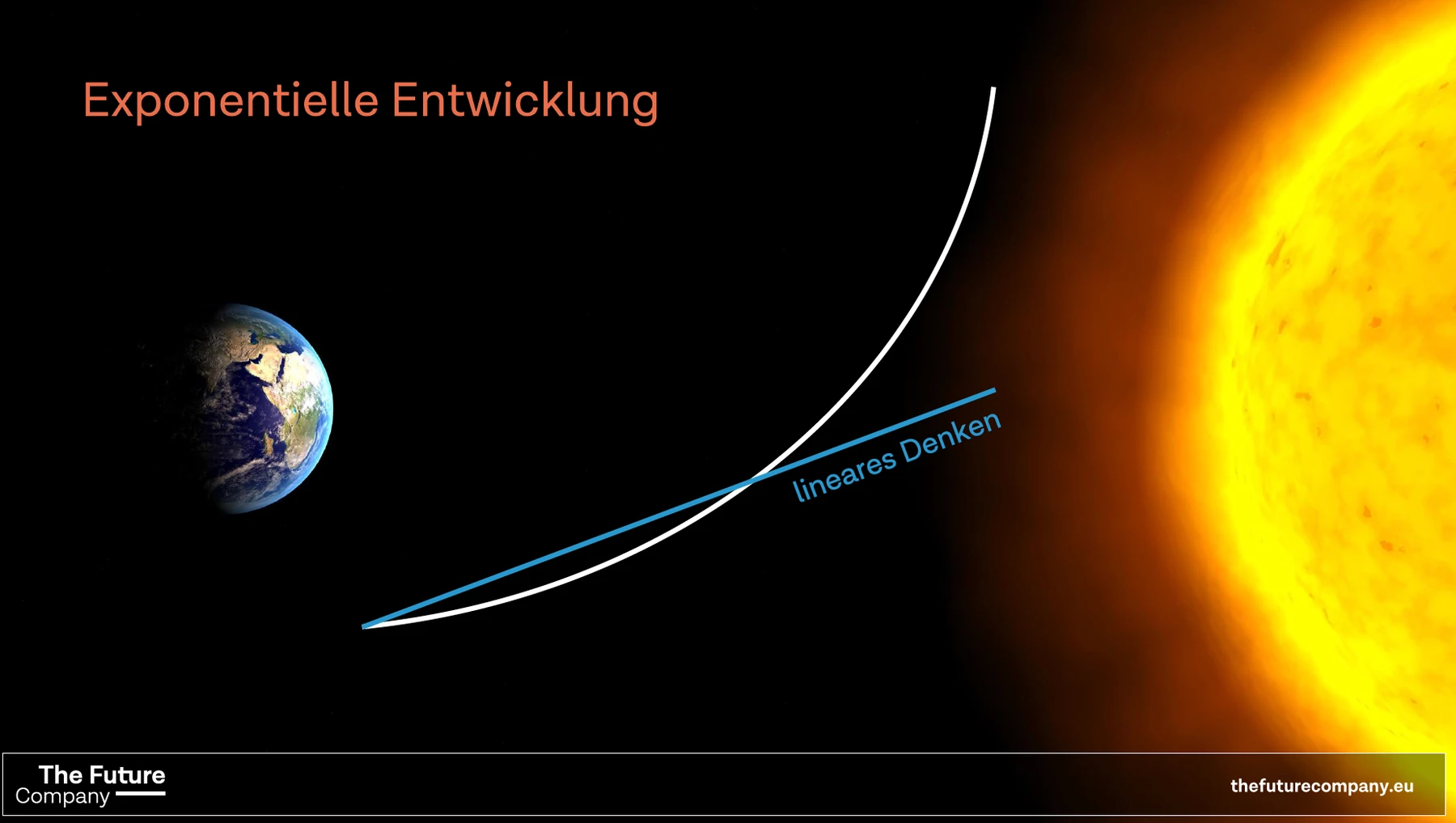
Menschliche Denkmuster vs. exponentiell voranschreitende Veränderungen.

Purpose, North Star and Moonshot Thinking

The terms purpose, North Star and Moonshot Thinking came up repeatedly. In these fast-moving times, they provide orientation and help employees and companies not to lose sight of their goals.

Purpose gives work meaning beyond profit and shows what a company stands for. It connects values with an overarching mission.

The North Star serves as a long-term orientation. It is a clear guiding point around which strategic decisions and improvements are aligned – and which ensures that everyone is working in the same direction. Defining and communicating the North Star is an essential leadership task.

Moonshot thinking complements these two concepts with the perspective of thinking big and differently. It encourages setting ambitious goals that go far beyond the obvious, thereby driving innovation and change.

Together, they form a framework in which future skills are understood not only as individual competencies, but as a collective attitude: creating meaning, providing direction and courageously breaking new ground.

Other key future skills:

  • Optimism about the future: Dare to make decisions and show confidence, even when the outcome is still unclear.
  • Fog competence: Remain capable of acting, even when not everything is clear – and take the first step courageously, without knowing the exact plan.
  • Critical thinking: Radically question the familiar – and sometimes deliberately argue against the grain.
  • Psychological safety: Create spaces where open thinking, mistakes and honest conversations are welcome.
  • Willingness to experiment: Give ideas space, try them out, learn from them – without fear of failure.
  • Value and meaning orientation: Provide stability and direction, even when the world is constantly changing.
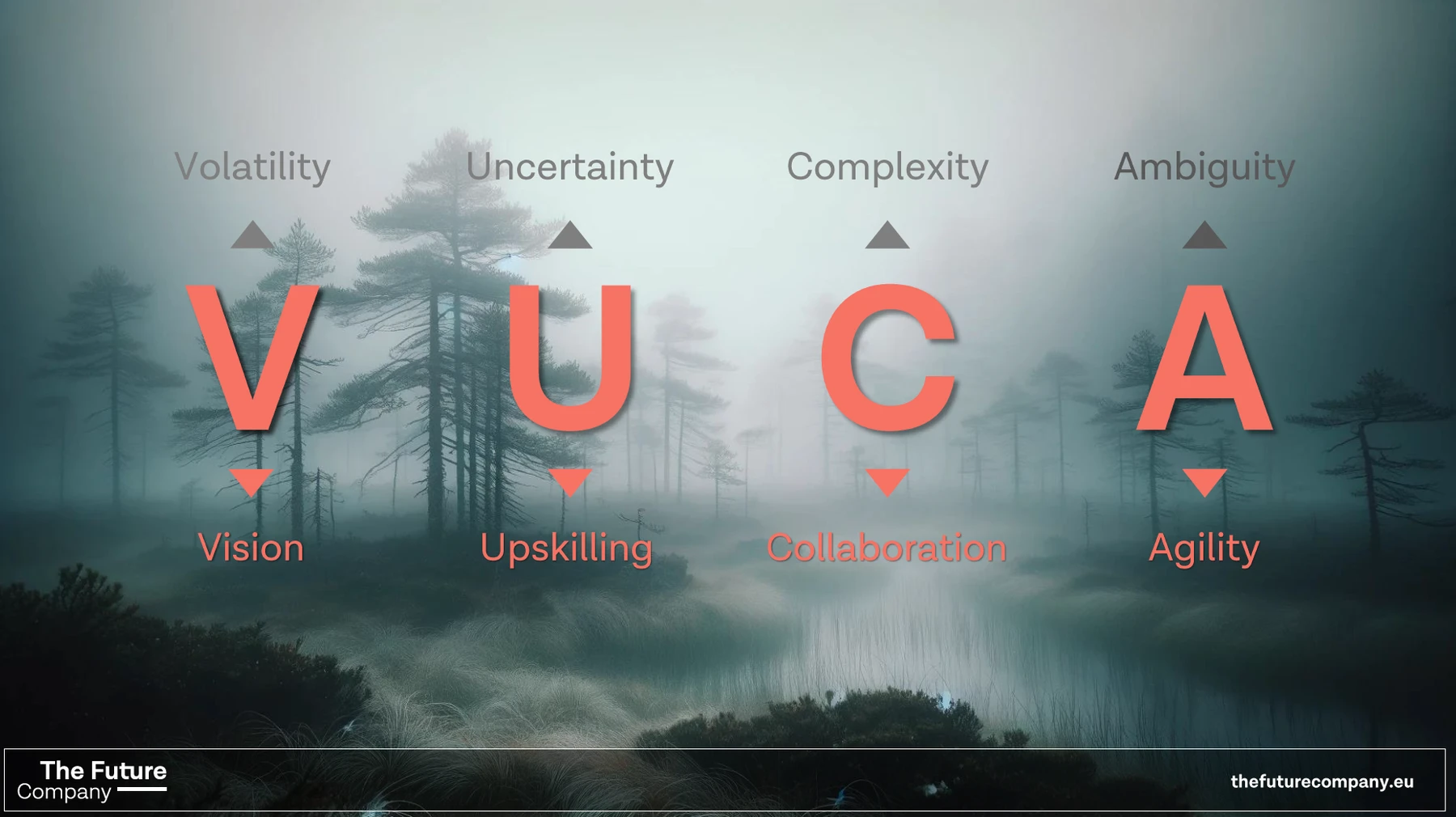
Das VUCA-Modell beschreibt die Herausforderungen der heutigen Märkte und welche Kompetenzen dafür gefordert sind.

Self-assessment vs. situation in the company: an honest look in the mirror

Participants used an interactive tool to assess their personal future skills – and those of their company. The conclusion: most rate their own skills higher than those of the organisation.

Conclusion from the survey:

  • Optimism about the future: clearly evident – the majority see themselves as drivers of change.
  • Fog competence: This is where the greatest difficulty lies: providing guidance without having all the answers yourself remains challenging.
  • Willingness to experiment: Often hampered by old routines and fear of risk.
  • Psychological safety: The area with the most obvious need for improvement.

Many managers openly asked themselves how credible they are as role models when it comes to transparency, error culture and dealing with uncertainty. These are also ideal conditions for a successful transformation.

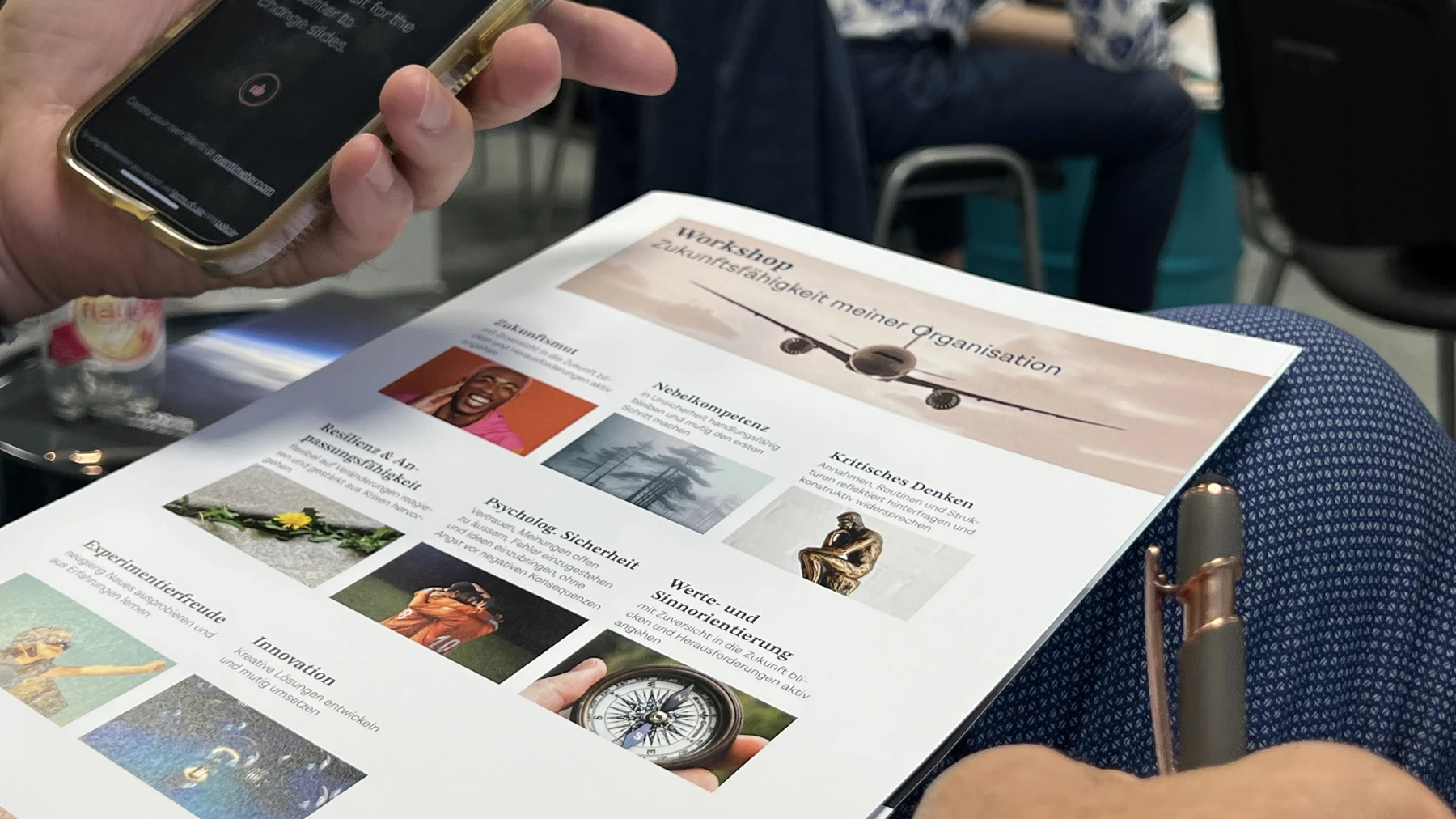
Die Teilnehmerinnen und Teilnehmer haben an den Events ihre eigene Situation bezüglich Future Skills reflektiert.

From IQ to WeQ – collaboration as a key skill in top management

One of the clearest lessons learned from the events: collaboration at the highest level is not a bonus, but a key skill for the future. This is because while individual knowledge (IQ) is increasingly being supplemented or replaced by AI, collective intelligence (WeQ) determines the strength and resilience of an organisation.

What does this mean in concrete terms for top management?

  • Shared responsibility with a clear focus
    WeQ does not mean a lack of leadership – it means a clear direction combined with the active integration of collective strengths.
  • Away from lone wolf leadership, towards genuine team leadership
    The future emerges where leadership teams think together, challenge each other, allow dissent and share uncertainty.
  • Cultural lever for change
    Whether silos or joint future planning dominate depends on the top. Transformation begins at the top – or remains empty rhetoric.
  • Psychological safety as a basis
    Collective intelligence only thrives in a culture where openness, criticism and mistakes are explicitly allowed.

Future skills at the highest management level – the key takeouts

  1. Growth mindset starts at the top
    Belief in development is not purely an HR task, but an important attitude for the future that must be supported and practised by all managers. Statements such as ‘That has worked so far’ reveal a fixed mindset. Managers must recognise obstacles, exemplify a willingness to learn and thus create the framework for growth.
  2. Fog competence as a leadership task
    Leadership does not mean having all the answers, but opening up spaces for dialogue, making decisions under uncertainty – and correcting them if necessary. The crucial question remains: ‘What does my team need to remain capable of acting?’
  3. Exemplifying a culture of error
    One thought from the discussion: ‘If we don't make any mistakes, something is wrong.’ Psychological safety comes from openly addressing mistakes – and from dealing honestly with one's own uncertainties.
  4. Making cultural change visible
    Change does not grow out of PowerPoint presentations, but through daily example. Top management must question routines and invest in the organisation's ability to learn. Culture is a matter for the boss.
  5. From IQ to WeQ – collaboration at the top
    Future viability comes from collective thinking, not individual decisions. Management committees must create space for diversity, dissent and joint problem-solving – and exemplify genuine collaboration themselves.

Conclusion

The will to change is there – now it's time for concrete steps. Growth mindset, psychological safety, collective intelligence and cultural change start at the top. If you want to shape the future, you have to tolerate uncertainty, allow different perspectives and act as a role model yourself.

One thing is certain: technology is changing our world. Whether companies merely react or actively shape the future is decided at the very top.

Dr. Martin Schwemmle
The Future Company

«The future does not demand ready-made answers, but rather a clear stance. Instead of clinging to old solutions, we need to ask new questions. This includes admitting ignorance and exploring unknown paths together with others. It is precisely this openness and willingness that I sensed at the events.»

Dr. Arndt Pechstein
The Future Company

«Shaping the future begins with an honest assessment of the current situation: where does the organisation stand, where do I stand as a manager? I was particularly impressed by the openness to self-reflection, the courage to recognise and seize opportunities for change – as well as inspiring examples that show how this can be achieved.»

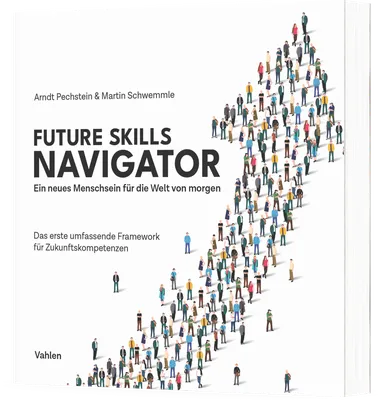
Dr Martin Schwemmle, economist, innovation researcher and communications expert, and Dr Arndt Pechstein, neuroscientist, biomimicry specialist and transformation expert, combine scientific expertise with practical implementation. With their company The Future Company, they are dedicated to the topic of future skills – and have jointly developed the Future Skills Navigator: a tool that supports managers and organisations in identifying, specifically promoting and strategically developing future skills.

In this book, Martin Schwemmle and Arndt Pechstein combine their abilities to analyse and inspire, highlight the need for change, and explain the diversity of future skills required for this in a systematic and understandable way.